
Commodities
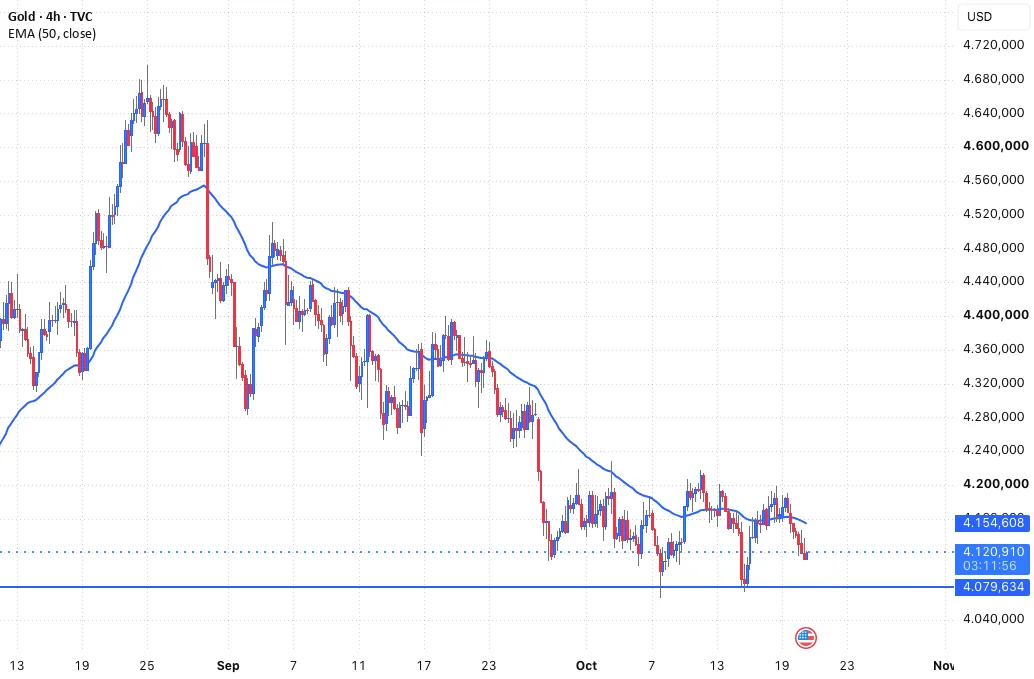
Gold loses momentum and looks again to $4,080 support
Rising oil prices and higher US Treasury yields are putting pressure on gold, while markets await Friday's preliminary US PMIs for fresh clues about economic growth and the outlook for interest rates.
Rising oil prices and higher US Treasury yields are putting pressure on gold, while markets await Friday’s preliminary US PMIs for fresh clues about economic growth and the outlook for interest rates.
Gold is moving lower again, approaching a key technical area around $4,080 per ounce, after failing to break above a significant trendline. A modest rebound in oil prices and US Treasury yields has reduced the appeal of the precious metal, which continues to trade unevenly in the absence of significant news capable of providing a clear direction for the markets.
This move comes amid growing uncertainty about the global economy. While equity markets remain under pressure due to concerns about the valuations of companies linked to artificial intelligence, commodity markets continue to be influenced by geopolitical risks and inflation expectations. For gold, the direction of US Treasury yields will be particularly important, as it affects the opportunity cost of holding an asset that pays no income.
US PMIs emerge as the key event of the week
Investors are now turning their attention to the preliminary US PMIs due on Friday. These indicators should provide fresh insights into business activity and help determine whether concerns about economic growth are justified.
Weaker-than-expected data could intensify fears of an economic slowdown and lead to a more moderate outlook for longer-term interest rates. If this scenario results in lower real Treasury yields, gold could regain its appeal and find support for a rebound from current levels.
Conversely, stronger-than-expected figures would ease growth concerns and could reinforce expectations that interest rates will remain elevated for longer. In that case, higher real yields would weigh on the precious metal and could extend its decline.
The market reaction will therefore depend not only on the economic data itself, but also on how it affects expectations for Federal Reserve policy. The relationship between growth, inflation and bond yields will be crucial in determining gold’s direction over the coming sessions.
Oil keeps geopolitical risks in focus
The energy market is adding another layer of uncertainty. Oil prices continue to extend their gains as negotiations between the United States and Iran remain stalled and the conflict between Saudi Arabia and the Houthis escalates, keeping the geopolitical risk premium elevated.
Reports from Al-Arabiya suggesting that progress in negotiations between Washington and Tehran could be announced this week remain unconfirmed. Previous reports of a similar nature have often failed to meet expectations, so caution is warranted. Hopes of an agreement can trigger immediate price movements, but they do not guarantee tangible diplomatic progress.
An unexpected agreement could trigger a significant correction in oil prices by reducing the geopolitical risk premium. Conversely, prolonged deadlock or further escalation would likely keep upward pressure on crude prices.
This creates a complex environment for gold. Higher oil prices can fuel inflation expectations and support demand for hedging assets, but they can also push nominal yields higher and make monetary easing more difficult. The ultimate impact will depend on which of these forces dominates.
$4,080: the technical level to watch
From a technical perspective, gold has struggled to break above a key trendline and is once again approaching the $4,080 per ounce area, which is emerging as the next important support level. The price reaction around this zone will be crucial in determining whether the current correction can stabilise or whether further downside remains likely.
A rebound from this area, accompanied by a decline in real yields, would strengthen the case for a recovery towards higher levels. Conversely, a decisive break below support would increase the risk of an extended sell-off.
Ultimately, gold faces a week in which US economic data and developments in the Middle East could prove decisive. Friday’s PMIs will be the main economic catalyst, while oil prices and Treasury yields will continue to shape the broader market environment. Until a clearer catalyst emerges, the precious metal is likely to remain sensitive to short-term market movements and uncertainty surrounding growth, inflation and interest rates.
Original analysis by Miguel A. Rodriguez, dated 20 October 2026.
This commentary is general market information, not investment advice. It does not take your objectives or financial situation into account, and past performance does not guarantee future results. Trading CFDs involves a significant risk of loss.