
Commodities
Gold under pressure ahead of a key week for markets
Gold stayed under pressure ahead of U.S. PCE inflation and payroll data. The medium-term view remained bearish, with a target around $3,950 per ounce.
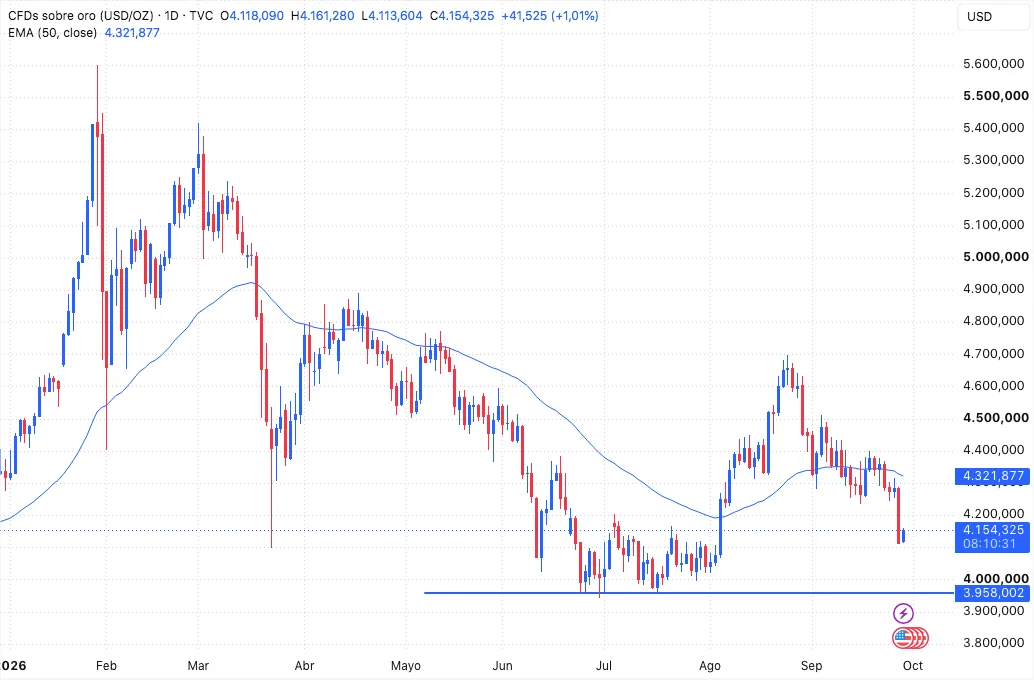
Markets were heading into a particularly important week that could help set the direction of major financial assets, with attention focused on the next key U.S. economic indicators.
PCE and payrolls set the rate outlook
The PCE inflation data, one of the price measures most closely watched by the Federal Reserve, was due on Wednesday, followed by the latest employment figures on Friday. Both indicators would be crucial in assessing the path of interest rates and expectations for Fed monetary policy.
More persistent-than-expected inflation, particularly if accompanied by a resilient labour market, could reinforce expectations that rates would stay elevated for longer, supporting the dollar and keeping bond yields high. Conversely, weaker data could revive expectations of rate cuts and ease some of the pressure on gold.
Geopolitics and oil send mixed signals for gold
Geopolitical uncertainty remained high. Negotiations between the United States and Iran were still inconclusive after Friday’s meeting, leaving the risk of a renewed escalation hanging over the market.
Oil prices, however, remained under some downward pressure after retreating from their recent highs. That could help moderate inflation expectations and reduce some of the pressure on central banks to keep policy restrictive. For gold, the effect was ambiguous: lower oil prices could support expectations of a less aggressive rate path, but they also reduced part of the premium associated with inflation risk and were not generating enough safe-haven demand to halt the metal’s correction.
A bearish medium-term view with a $3,950 target
Against this backdrop, gold continued to show a vulnerable structure. Still-high interest rates, the possibility that the Fed would hold a restrictive policy for longer and a potentially stronger dollar remained sources of pressure, while geopolitical uncertainty continued to provide some support. The market’s reaction to the PCE and employment data would therefore be particularly important in determining whether the correction deepened.
From a medium-term perspective, the view on gold remained bearish, with a target around $3,950 per ounce. The decline did not have to be linear: a significant increase in geopolitical tension or a sharp change in rate expectations could trigger temporary rebounds. As long as inflation continued to constrain the Fed and bond yields stayed elevated, however, the balance of forces remained unfavourable for the precious metal.
Original analysis by Miguel A. Rodriguez, dated 29 September 2026.
This commentary is general market information, not investment advice. It does not take your objectives or financial situation into account, and past performance does not guarantee future results. Trading CFDs involves a significant risk of loss.